
Why does a wall panel look stunning in a catalogue but fail to impress once installed?
Perhaps the joints are too visible. Perhaps its texture overwhelms a small room. Or the technical documents are missing.
For architects working on hotels, offices, retail spaces and renovation projects in Germany, selecting decorative PU wall panels involves more than approving a visually appealing sample.
The material must complement the architectural concept, work with the proposed installation details and meet the technical and maintenance requirements of the space.
Choosing the right decorative PU wall panel supplier means finding a manufacturing partner who understands these considerations beyond the initial design selection.
What Matters Beyond the Design?
A good Decorative PU Wall Panel Supplier should simplify decisions, not create problems after approval. Here’s what matters.
1. Texture Should Suit the Space
Rugged rock behind a restaurant counter? Interesting. The same texture along a narrow office corridor? Potentially overwhelming. In contemporary architectural projects where clean detailing and restrained material combinations are central to the design concept, decorative textures should complement the space rather than compete with other architectural elements. That doesn’t mean walls must be boring. It means the texture needs a purpose.
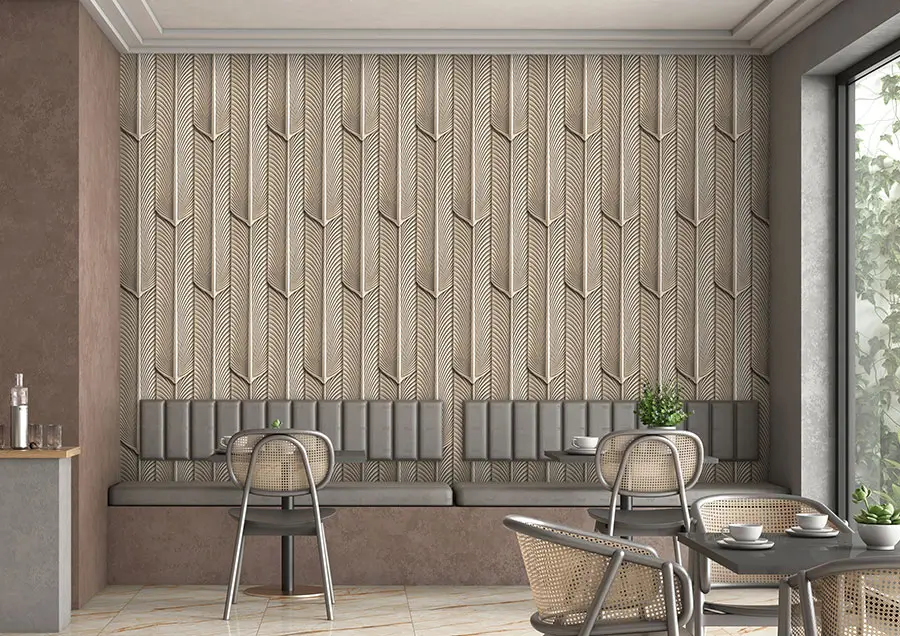
Stone and brick looks can introduce warmth. Geometric 3D patterns work differently, using shape and shadow to create interest. When comparing a Decorative PU Wall Panel Supplier, look for genuinely different design directions rather than dozens of similar patterns.
2. One Sample Isn’t an Entire Wall
A single panel is easy to love. Twelve panels together tell another story.
Does the pattern repeat too obviously? Do the joints interrupt the design? Does the shade change beside a window? Ask your Decorative PU Wall Panel Supplier for accurate dimensions and physical samples. Place multiple pieces together before approval.
This matters for hotels and retail chains where one finish covers multiple walls. Nobody wants to discover a repeating pattern after installation.
3. Can Someone Actually Install It?
Architects should not only define the required texture. They should also explain how to treat corners, doors and electrical holes. This will bring the thickness of the panel, detailing of edges and fixing and cutting processes into discussion.
The Decorative PU Wall Panel Supplier has to provide guidance on installation instead of just a photo of the finished wall. It is also necessary to check the substrate in case of refurbishment work. The panels are lightweight and easy to handle. However, it is still necessary to create the conditions for fixing them. The drawing should be used on a real wall.
4. The Paperwork Has a Purpose
It’s not a bedroom but a hotel reception and it’s not a stylish display but a busy corridor. German construction projects differ in their fire performance and indoor air regulation requirements.
When you are thinking of working with any Decorative PU Wall Panel Supplier, make sure to request technical data, testing results, and installation instructions for the product before making any decisions. It’s also important to check if the product offered along with the fixing system will match the project’s needs.
The unproven statement that something is fire-resistant is meaningless. Consider that indoor emissions need to be investigated as well.
5. Light Is Part of the Material
Panel with grooves that are quite deep can be subtle while it is lighted up during the day and look very stylish when spotlights are used. There are times when that is the intention of the designer and times when it makes everything look uneasy.
It is essential to compare different variants under both types of light. Monitor changes in the shadows and brightness as well. A good Decorative PU Wall Panel Supplier will assist customers in making the right choice when it comes to finishes which is impossible by simply looking at pictures.
6. Think About Tuesday Morning, Not Opening Night
There might be dirt on deep textures. Common locations might be impacted by furniture or luggage. Different finishes need different cleaning types. Ask the Decorative PU Wall Panel Supplier about the maintenance of the panels and if they are suitable for the selected place. A café accent wall and a busy hotel corridor have different requirements. High-quality solution should not make life harder but rather bring a lot of ease.
7. Can You Match It Next Year?
Projects change. A hotel extends its reception area. A retail chain opens another branch. If the original finish is discontinued or inconsistent, matching the design becomes difficult.
Discuss repeat-order availability and batch variation with your Decorative PU Wall Panel Supplier before committing to a signature texture. One beautiful wall is good. A repeatable design serves an entire property portfolio.
Why Export with Artisun Industries?
Artisun Industries offers stone, brick, rock and 3D PU wall panels, including Ocean Wave, Flute Peak and Diamond Cut. For German architects and importers seeking a Decorative PU Wall Panel Supplier, its offering includes:
- A variety of natural and geometric textures
- In-house manufacturing
- Paid sample kits
- Multiple panel sizes
- Custom development for qualifying orders
- Export-focused bulk supply
Choose What Works Beyond the Moodboard
A successful wall isn’t necessarily the one with the boldest texture. It’s the one that looks right, fits the details and remains practical after handover. Choose a Decorative PU Wall Panel Supplier with those priorities in mind. Explore Artisun Industries catalogue and contact the export team for samples, specifications and German project enquiries.
Most Popular Questions
What should architects look for when choosing decorative PU wall panels?
Architects should evaluate material quality, texture, panel dimensions, pattern continuity, installation requirements, relevant technical documentation, maintenance and future product availability.
What should architects expect from a decorative PU wall panel supplier?
A suitable supplier should provide clear product specifications, physical sample options, installation information, relevant technical documentation and details about order quantities and product availability.
Are decorative PU wall panels suitable for commercial interiors in Germany?
Suitability depends on the specific panel, intended application, installation system and applicable building requirements. Architects should verify relevant fire-performance, indoor emissions and technical documentation before specification.
Do decorative PU wall panels require CE marking in Germany?
CE marking requirements depend on the product classification and applicable European regulatory framework. Architects and importers should confirm the requirements for the specific product.
Why should architects evaluate multiple wall panels before approval?
Evaluating adjoining panels helps architects assess pattern repetition, joint visibility, shade consistency and the overall visual effect across a larger wall surface.
How does lighting affect 3D PU wall panels?
Lighting direction, intensity and colour temperature can influence shadows, perceived colour and surface depth. Architects should evaluate panels under representative project lighting conditions.
Can Artisun Industries develop customised PU wall panel designs for architectural projects?
Artisun Industries offers custom product development possibilities for qualifying projects, subject to design feasibility, mould requirements, minimum order quantities and commercial terms.
Can German architects request PU wall panel samples from Artisun?
Artisun Industries offers chargeable sample kits for evaluating decorative textures and finishes. Architects can contact the team to discuss available collections and project requirements.

Leading PU Wall Panel Manufacturer
As a proud representative of Artisun Industries, a leading PU Wall Panel manufacturer, I bring our expertise in crafting high-quality, durable PU Wall Panel tailored to meet diverse architectural needs. Join us in exploring innovative solutions that transform spaces beautifully!