
A refurbishment project can lose money without anything actually going “wrong.”
One extra week of work means another week before hotel rooms can be booked. Another weekend with a retail section closed. Another few days of contractors working around employees in an occupied office.
That is why refurbishment is increasingly about how much disruption a design decision creates, not simply how good the finished space will look.
This matters in the UK, where repair and maintenance remains a significant part of construction activity. In the three months to May 2026, Great Britain’s non-housing repair and maintenance output grew by 3.0%, according to the Office for National Statistics.
Against that backdrop, PU Wall Panel solutions are becoming relevant for hotels, restaurants, offices, shops and other commercial spaces that want a strong visual transformation without making the renovation unnecessarily complicated.
PU wall panels can offer refurbishment teams a lightweight decorative wall-finishing option with a wide range of textures and visual styles. Their handling and installation characteristics can be useful where projects need to minimise material movement, site disruption and programme delays. Suitability still depends on the specific panel, wall condition, installation method and requirements of the project.
What Is a PU Wall Panel?
A PU wall panel is a decorative wall-finishing panel made using polyurethane, typically designed to reproduce the appearance and texture of materials such as stone, brick, rock, wood or other architectural surfaces. PU wall panels are used for feature walls and decorative interiors across residential, hospitality, retail, office and commercial projects.
For refurbishment projects, their relevance comes from the combination of decorative flexibility and comparatively lightweight handling. However, installation requirements, moisture suitability, fire performance and maintenance should be assessed according to the specific product and intended application.
Why Are Refurbishment Teams Looking Beyond Traditional Wall Finishes?
The old question was: “Which finish looks best?”
Today, project managers are also asking: How quickly can it be installed? How difficult is it to move around the site? How much additional work does it create? And how soon can the space return to business?
A Feature Wall Shouldn’t Become a Construction Project of Its Own
A restaurant wants a stone-look backdrop behind the bar.
Simple enough.
Then traditional stone enters the conversation: weight, cutting, handling, specialist installation and additional site work.
Suddenly, one decorative wall is affecting the programme.
A PU Wall Panel offers another route. High-density polyurethane panels can reproduce stone, brick, rock and other textured surfaces while remaining lightweight and easier to handle than many traditional decorative materials.
That makes them particularly useful when the objective is to change how a space feels without rebuilding the wall itself.
Less Weight Matters More in Existing Buildings
New construction starts with a blank structure.
Refurbishment rarely does.
Contractors may be working around existing partitions, lifts, narrow corridors, completed floors and services that cannot simply be redesigned.
Now picture carrying heavy decorative materials through several floors of an operating hotel.
Every movement takes time.
A lightweight PU Wall Panel can simplify transport from delivery point to installation area. For larger refurbishments with dozens of rooms or multiple retail units, those small efficiencies begin adding up.
The benefit is not dramatic engineering.
Sometimes it is simply making the contractor’s day easier.
And in refurbishment, easier often means faster.
Commercial Projects Need the Space Back Quickly
A homeowner might tolerate an unfinished room for a few extra days. A business views those days differently.
For a hotel, an unavailable room has no booking revenue. For a retailer, hoarding hides selling space. For a restaurant, a delayed reopening means empty tables.
This is why installation time has commercial value.
PU wall panel systems can offer a comparatively straightforward installation approach for suitable applications, potentially reducing some of the labour and site activity associated with more complex decorative finishes. The actual installation time depends on wall preparation, panel dimensions, cutting, fixing method, detailing and the condition of the existing substrate.
One System Can Create Very Different Interiors
Speed would mean very little if every finished project looked the same.
- A Manchester office does not want the same personality as a London boutique hotel.
- A restaurant may want exposed-brick character.
- A spa could prefer softer stone.
- A retail store may want a strong geometric feature wall.
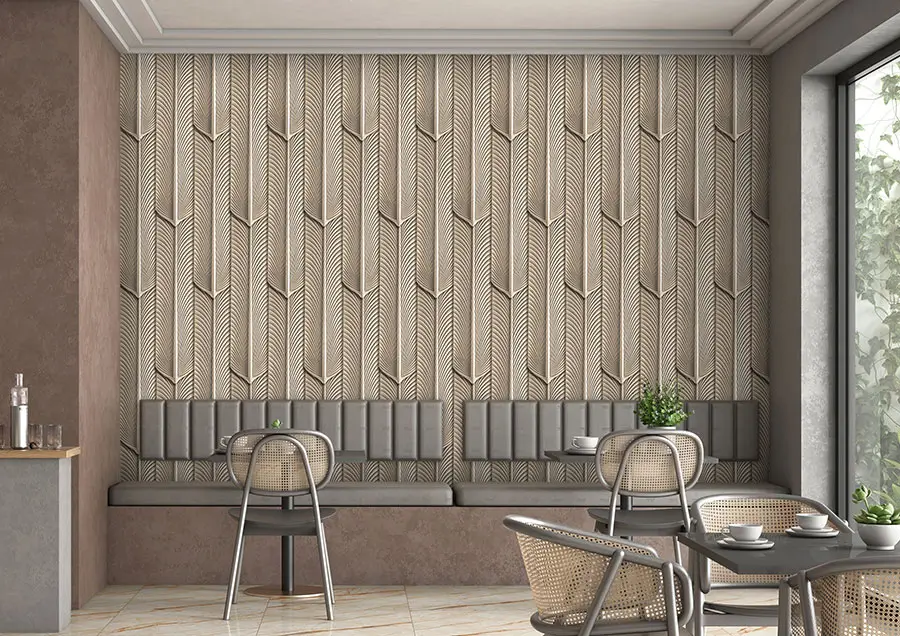
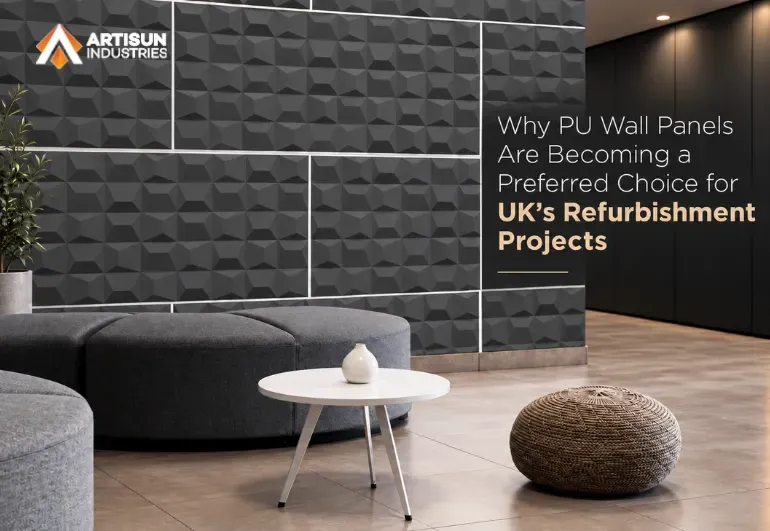
The growing variety within the PU Wall Panel category gives designers more freedom to achieve those different identities. Current ranges include natural stone, brick, rock and three-dimensional architectural textures.
For refurbishment companies handling different sectors, this has a practical advantage. They can become familiar with one broad wall-panel system without limiting every client to one visual style.
Refurbishment Is Also About What You Don’t Disturb
There is another side of renovation that rarely makes it into the mood board.
- Dust
- Debris
- Repeated material movement
- Long periods of noisy site activity
These are much easier to tolerate on an empty construction site than inside a partly operational hotel, office or commercial building.
Using lighter, installation-friendly decorative systems can help reduce some of that site complexity.
That is one reason the PU Wall Panel makes sense particularly in refurbishment: the value is not only what gets added to the wall, but what the project may avoid having to do around it.
Why Export with Artisun Industries?
Artisun Industries supports UK importers, distributors, contractors and project buyers with in-house manufacturing and export-focused supply. Artisun Industries offers 45+ PU wall panel designs across stone, brick, rock and contemporary decorative styles, giving UK buyers a broader selection when sourcing panels for different refurbishment sectors.
For international buyers, the export offering includes:
- Lightweight PU Wall Panel collections
- Sample support before bulk orders
- In-house manufacturing and quality control
- Custom-development possibilities
- Secure export packaging
- Production scheduling for larger requirements
- Documentation and logistics support
Renovate the Interior, Not the Timeline
A successful refurbishment should make customers notice the new space, not how long it took to finish.
Explore the Artisun Industries catalogue for stone, brick, rock and decorative PU Wall Panel collections, and connect with the export team to discuss samples and bulk requirements for the UK market.
Most Popular Questions
Why are PU wall panels useful for refurbishment projects?
PU wall panels can provide decorative stone, brick, rock and other textured finishes while offering comparatively lightweight handling, making them worth considering for suitable refurbishment applications.
Are PU wall panels suitable for UK commercial interiors?
They can be suitable for selected commercial applications, but buyers should verify the specific product's fire performance, moisture suitability, installation requirements and other project-specific specifications.
Are PU wall panels faster to install than traditional wall finishes?
Installation time varies by product, substrate and project conditions. PU panels can offer a comparatively straightforward installation approach in suitable applications, but actual programme savings depend on the project.
Where can PU wall panels be used in refurbishment projects?
They can be used for selected feature walls and decorative areas in hotels, restaurants, offices, retail spaces, cafés, showrooms and other interiors, subject to product specifications.
What should UK importers check before buying PU wall panels?
They can be used for selected feature walls and decorative areas in hotels, restaurants, offices, retail spaces, cafés, showrooms and other interiors, subject to product specifications.
Can PU wall panels be customised?
Customisation depends on the manufacturer's capabilities, design-development process and MOQ. Buyers should discuss requirements before placing an order.

Leading PU Wall Panel Manufacturer
As a proud representative of Artisun Industries, a leading PU Wall Panel manufacturer, I bring our expertise in crafting high-quality, durable PU Wall Panel tailored to meet diverse architectural needs. Join us in exploring innovative solutions that transform spaces beautifully!