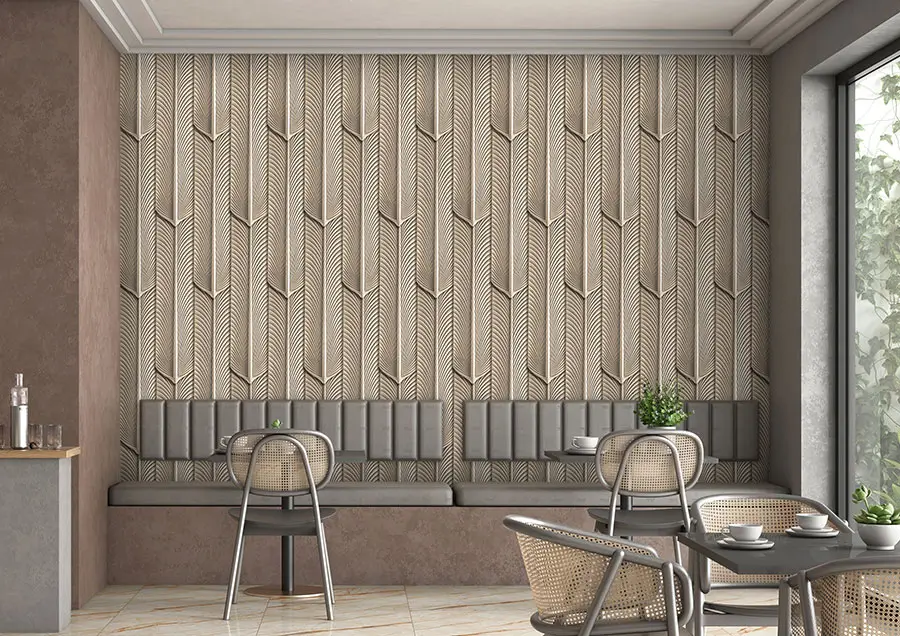

A wall panel can look excellent in a sample box and still become a poor import decision.
For a UK buyer, the real evaluation starts after the design is approved. What is it made from? How tightly are dimensions controlled? What evidence supports performance claims? Will repeat batches match? Can the packaging survive container movement?
Importers are taking responsibility for a product that will move through distributors, installers and commercial projects.
So instead of starting with “What is your best price?”, start with the specification.
Treat the Product Data Sheet Like a Buying Tool
A technical team should compare suppliers against measurable criteria, not simply judge texture from photographs.
1. Ask for the Physical Specification, Not Just “High Density”
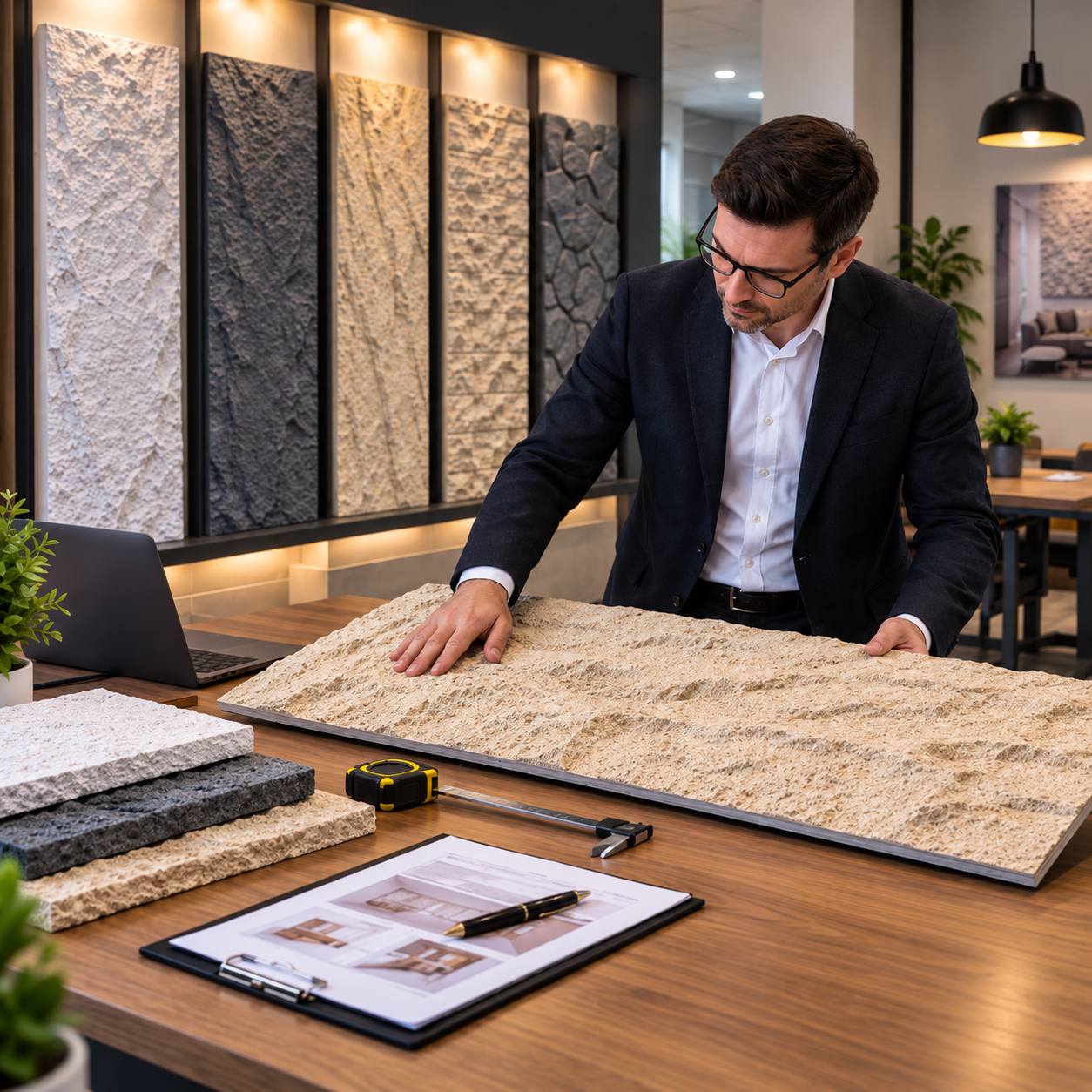
Polyurethane wall panel can vary in formulation, thickness, weight and rigidity.
Ask for material construction, nominal dimensions, panel thickness, unit weight and dimensional tolerances.
A leading exporter identifies its panels as high-density polyurethane foam and lists formats including 200×900, 300×1200, 600×600 and 600×1200 mm.
Why does this matter?
Across a hotel or retail rollout, small dimensional variations can become visible at joints. They can also increase cutting, adjustment and installation time.
For bulk buyers, consistent specification beats impressive adjectives.
2. Never Accept “Fireproof” as the Entire Fire Specification
This is where technical procurement needs to become uncomfortable—in a good way.
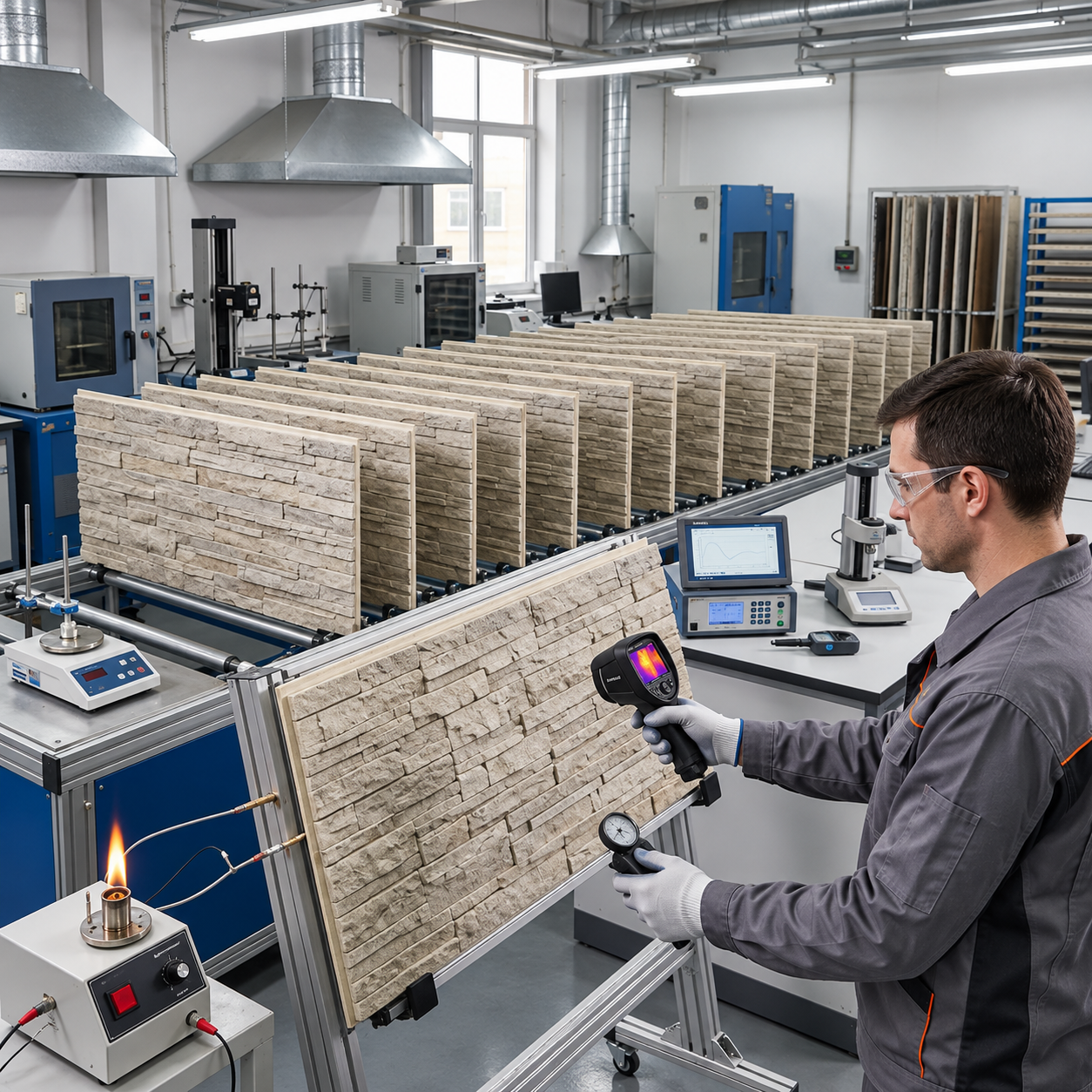
If a manufacturer describes Decorative PU Wall Panels as fireproof or fire-resistant, ask for the evidence behind the statement.
Check:
- Test method
- Classification achieved
- Testing laboratory
- Report date
- Tested product construction
- Intended application covered by the test
Current UK construction-product guidance emphasises due diligence, factory production control and reliable product information.
3. Check 10 Panels, Not One Beautiful Sample
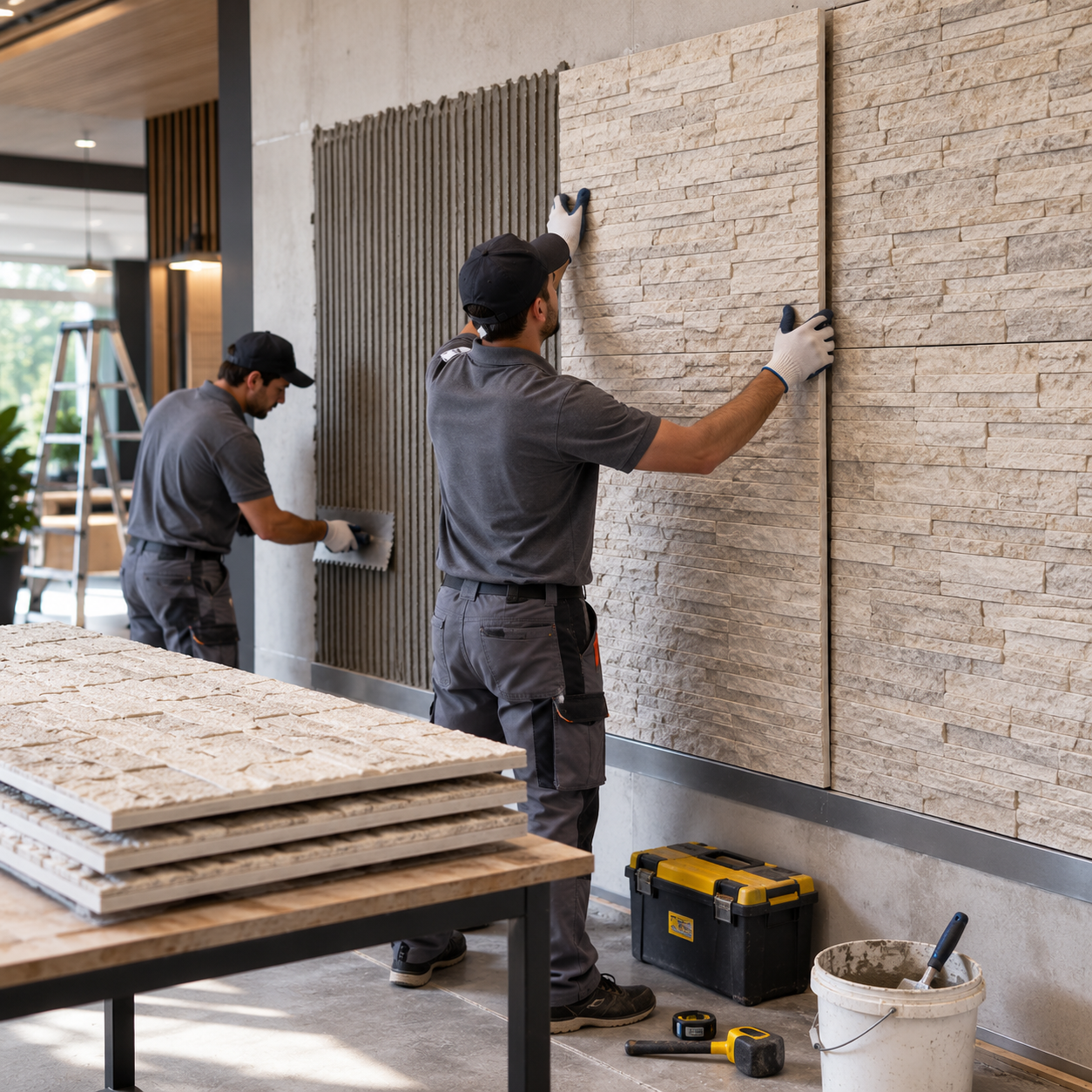
Natural-looking surfaces have another technical challenge: repetition.
One stone texture can look excellent.
Put twenty pieces across a restaurant wall and suddenly the same rock formation appears every few metres.
Request multiple samples of Decorative PU Wall Panels and lay them together.
Look for:
- Colour consistency
- Texture repetition
- Edge quality
- Coating uniformity
- Visible joints
- Surface defects
Check them under both warm and cool lighting.
For architects and hospitality projects, establish an approved master sample before production. Repeat orders should then be evaluated against the same reference.
4. Understand the Installation System Before Importing

“Easy installation” is useful marketing. Your contractor needs more information. What substrate can the product go over? Which adhesive is recommended?nHow are panels cut? How should joints and corners be finished? Does exterior installation require different preparation?
A leading exporter positions its Decorative PU Wall Panels as lightweight and fast to install, with products for interior and exterior applications.
Importers should still obtain application-specific guidance before selling into different project environments.
Because when something fails on a Birmingham restaurant site, the contractor isn't calling the factory first.
They're calling you.
5. Audit the QC Process, Not the QC Logo
Almost every manufacturer says “strict quality control.”
- Ask what that actually means.
- Are dimensions measured?
- Are surfaces visually inspected?
- Are colours checked between batches?
- Are damaged edges rejected?
- Is packing quantity verified?
A leading exporter says its panels are manufactured in-house, supported by dedicated R&D and quality-control processes. Its UK operation also highlights checks around dimensions, surface texture, strength and finish consistency.
For an importer, direct production control reduces the number of unknowns between sample approval and final shipment.
6. Treat Packaging as Part of the Product Specification
A perfect panel with a broken corner has exactly one commercial value:
Zero.
Ask for carton dimensions, pieces per carton, gross and net weight, loading method and photos of previous export packing.
A leading exporter states that international orders use transit-safe packaging and documentation including packing lists, specifications and certificates of origin.
Review those details before dispatch, not after opening the container in the UK.
Decorative PU Wall Panel Import Checklist
| Specification | Why It Matters |
| Material composition | Influences strength, weight, and durability |
| Panel dimensions | Affects joint alignment and installation efficiency |
| Fire-test evidence | Supports technical evaluation for commercial projects |
| Surface consistency | Reduces visible variation across large installations |
| Installation guidance | Helps contractors avoid application problems |
| Quality-control process | Improves repeat-order reliability |
| Export packaging | Protects panels during container transport |
Why Source Decorative PU Wall Panels from India?
India becomes commercially interesting when the advantage goes beyond price.
UK importers can work directly with manufacturers capable of combining design development, moulding, finishing, production and export preparation within one supply relationship.
That can make it easier to develop exclusive collections, test new textures and consolidate multiple categories.
The better sourcing question isn't:
“Is India cheaper?”
It's: “Can this supplier give us better control over product, margin and range development?”
Why Artisun PU Wall Panels?
Artisun Industries is particularly relevant for buyers who prefer quality, durability and want to deal directly with the manufacturing side rather than another trading layer. Our panels are designed, developed and manufactured in-house, supported by R&D and export-focused fulfilment.
For UK importers, that means access to:
- 45+ ready-to-order designs
- Stone, brick, rock and textured surfaces
- Sample kits for technical evaluation
- In-house manufacturing and QC
- Custom design development
- Export-standard packaging and documentation
- Wholesale, private-label and bulk-order discussions
Import the Specification, Not Just the Look
The right Decorative PU Wall Panels should pass three tests: sample approval, site performance and repeat-order consistency.
Source with technical evidence, defined specifications and clear quality controls from day one.
Then your next container isn't a gamble on a beautiful sample. It's inventory your dealers can specify confidently, sell repeatedly and ask you to restock. Connect with us to know more about our products and pricing details.
Most Popular Questions
What should UK importers check before buying Decorative PU Wall Panels?
UK importers should verify material composition, panel dimensions, fire-test documentation, batch consistency, installation compatibility, quality-control procedures, and export packaging before placing bulk orders.
Are Decorative PU Wall Panels suitable for commercial projects?
Yes. Decorative PU Wall Panels are commonly used in hotels, restaurants, retail stores, offices, and other commercial interiors where lightweight construction and decorative finishes are important.
Why is fire-test evidence important when importing wall panels?
Fire-test evidence helps confirm how the specific panel construction performed under a recognised test method, which is important for commercial and hospitality projects.
What causes problems with repeat orders?
The most common issues are colour variation, texture inconsistency, dimensional differences, packaging damage, and changes in panel construction between production batches.
Why do UK distributors source Decorative PU Wall Panels from India?
India offers broad design collections, scalable manufacturing, custom-development capability, competitive bulk production, and export-ready supply support for distributors and project buyers.

Leading PU Wall Panel Manufacturer
As a proud representative of Artisun Industries, a leading PU Wall Panel manufacturer, I bring our expertise in crafting high-quality, durable PU Wall Panel tailored to meet diverse architectural needs. Join us in exploring innovative solutions that transform spaces beautifully!